
Perimenopause Sleep and Weight Gain: The Connection Most Women Miss
By Dr. Nadia Saleem, ND,
Menopause Society Certified Practitioner
When women describe what’s changed for them in perimenopause, sleep almost always comes up — trouble falling asleep, waking through the night, feeling wired but exhausted. What often doesn’t come up, at least not right away, is that this same disrupted sleep may be one of the biggest reasons the weight isn’t shifting.
Poor sleep isn’t just uncomfortable. It’s an active driver of weight gain in this stage of life — and addressing it is often more effective than adding another diet change.
The chain, not the checklist
Here’s how this actually works, one link at a time.
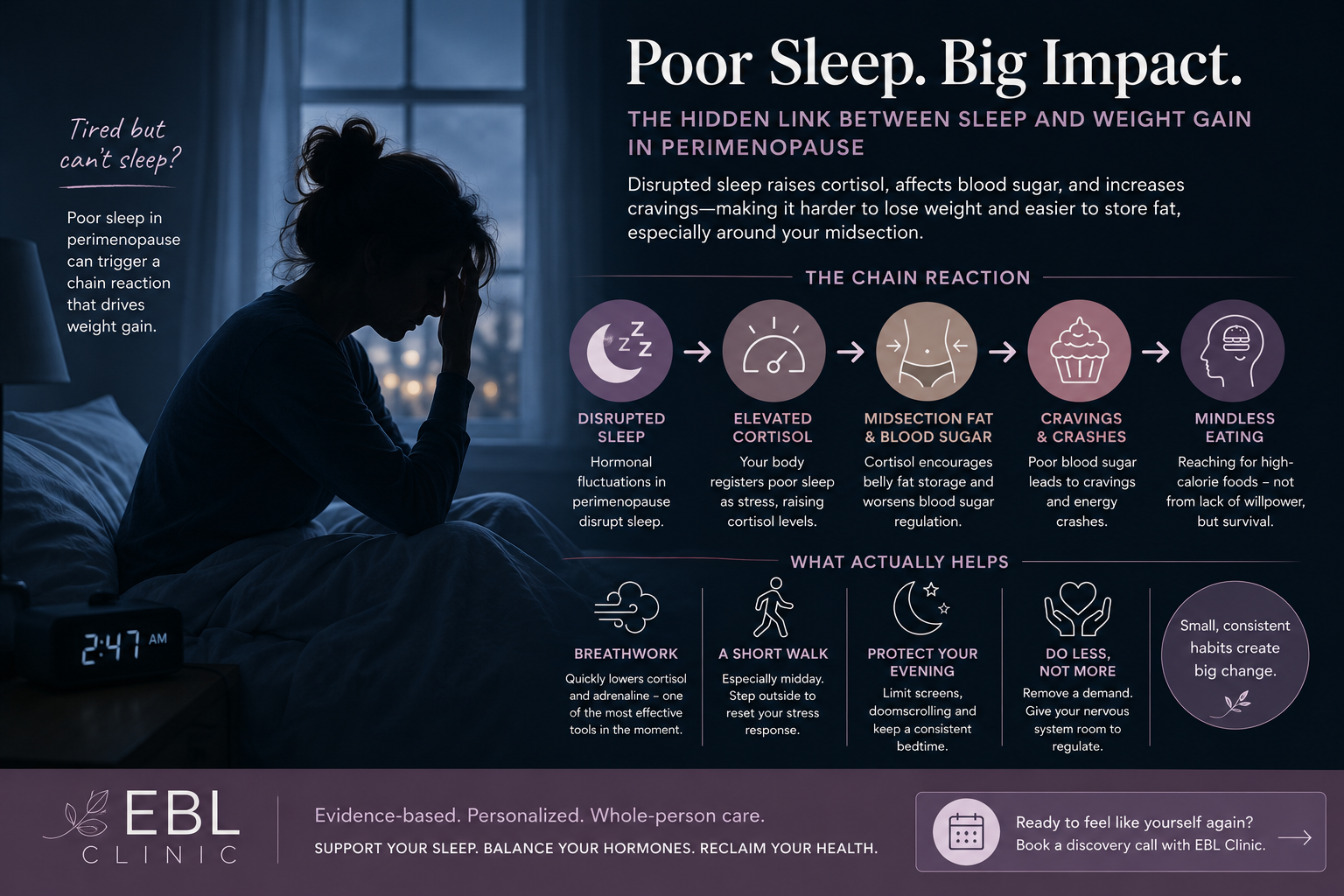
Hormonal fluctuations in perimenopause disrupt sleep. Your body registers poor sleep as a genuine physical stressor — not a minor inconvenience, but the same category of stress as illness or overexertion. In response, cortisol rises. Elevated cortisol specifically encourages fat storage around the midsection and makes it harder for your body to regulate blood sugar well.[1] (This is closely tied to the insulin resistance many women develop in perimenopause — more on that mechanism here.) Poorer blood sugar regulation shows up as cravings and energy crashes. Cravings and crashes lead to reaching for fast, high-calorie food — not from a lack of discipline, but because your body is genuinely asking for quick fuel.
That’s the full chain: disrupted sleep → cortisol → midsection fat storage and worse blood sugar control → cravings → mindless eating. It’s one connected cycle, not four unrelated symptoms — which is exactly why treating them as separate problems (a supplement for cravings, a different one for stress, another for sleep) tends to underperform.
Why “just relax more” isn’t the answer either
I want to be honest about something: cortisol itself isn’t the enemy. You need cortisol to rise when you’re genuinely under acute stress — it’s part of what gets you through a demanding day. The goal isn’t to eliminate cortisol. It’s to stop it from staying elevated when the stressor has passed, and to give your body real, regular opportunities to come back down.
This is also where I’ll push back gently on stacking more supplements as the first move. Before adding anything, it’s worth asking whether there’s a simpler, non-negotiable lever available — because often there is, and it costs nothing.
What actually helps, starting today
Breathwork, genuinely. It sounds almost too simple to matter, but it’s one of the more evidence-backed ways to bring cortisol and adrenaline down quickly in the moment — more reliable, in the short term, than most supplements.
A short walk, especially midday. If you’re tied to a desk and stress tends to build through the day, even a brief walk outside removes you from the stimulus that’s keeping cortisol elevated. If a full walk isn’t possible, a few minutes of deliberate deep breathing away from your desk does something similar.
Protecting your evening wind-down. The controllable pieces — screens late at night, doomscrolling, inconsistent bedtimes — matter even though they won’t fix everything (some sleep disruption in this stage is genuinely hormonal and outside your control). Focus your energy on what you can actually influence.
Doing less, not just doing more. This is the piece that surprises people: sometimes the most effective intervention isn’t adding a habit, it’s removing a demand. Taking something off your plate to give your nervous system room to regulate is a legitimate strategy here — not a consolation prize for when you “can’t” do more.
The bottom line
If sleep has changed for you in perimenopause, that’s not a side issue to your weight — it may be one of the more central ones. The cycle of disrupted sleep, elevated cortisol, and midsection fat storage responds well to consistent, small, non-negotiable habits — not to another restrictive diet layered on top of an already-stressed system.
If sleep disruption is a significant part of your day-to-day and you haven’t been able to get ahead of it, it’s worth looking at what’s actually driving it for you specifically. Learn more about our approach to perimenopause and menopause health, or book a discovery call with EBL Clinic →
Related reading: - What’s actually happening to your metabolism in perimenopause - Why cravings and crashes aren’t a willpower problem: perimenopause and insulin resistance - Does hormone therapy actually help with perimenopause weight gain?
References
[1] International Menopause Society. IMS 2026 Recommendations on Women’s Midlife Health and Menopause Hormone Therapy. imsociety.org