
Perimenopause and Insulin Resistance: Why Cravings and Crashes Aren’t a Willpower Problem
By Dr. Nadia Saleem, ND,
Menopause Society Certified Practitioner
I often see women who’ve noticed a change they can’t quite explain: sugar cravings that weren’t there before, an afternoon crash that hits like a wall, or belly fat that won’t move no matter what they cut back on. Sometimes it’s a partner who mentions it first — noticing new skin tags and wondering out loud if it’s connected to blood sugar.
It’s not a discipline problem. It’s a hormonal one — and it’s more common than most women realize.

What’s actually changing
As estrogen declines through perimenopause, your body’s relationship with insulin shifts. Insulin is the hormone that manages blood sugar — and estrogen plays a real role in keeping that system running smoothly. As estrogen becomes less stable, many women develop a mild, gradual insulin resistance, meaning the body needs to work harder to keep blood sugar in a normal range.[1]
This is compounded by the same shift we see with weight distribution more broadly: as fat accumulates more centrally, around the abdomen, that specific type of fat is itself metabolically active and tends to worsen insulin resistance further.[2] (If you haven’t already, this piece on what’s actually happening to your metabolism in perimenopause walks through why that midsection shift happens in the first place.) It becomes a loop — declining estrogen contributes to central fat gain, and central fat gain contributes to worsening insulin sensitivity.
Why this shows up as cravings, not just numbers on a lab test
This is the part that catches most women off guard: insulin resistance rarely announces itself as a diagnosis. It shows up as symptoms first.
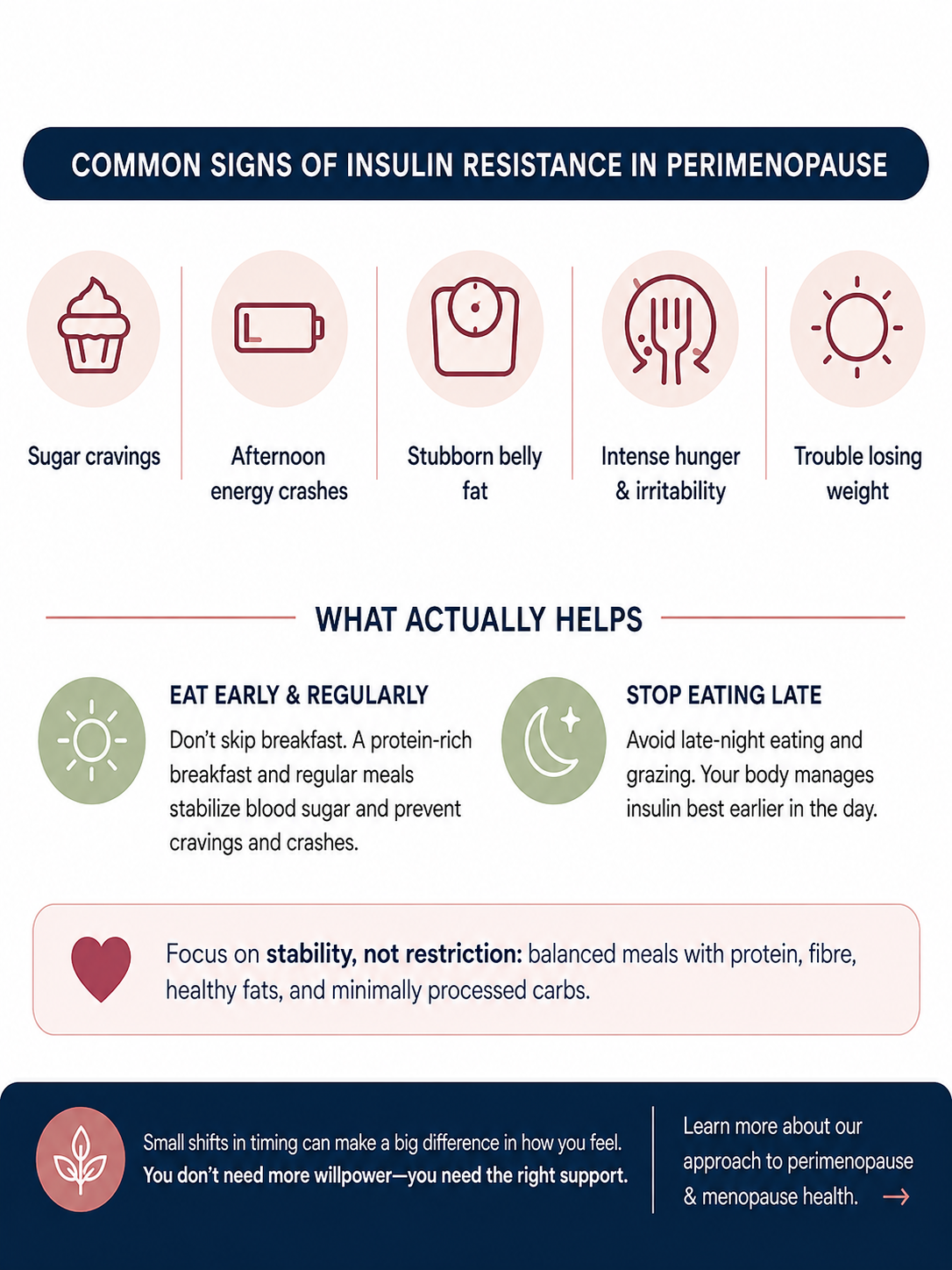
Sugar cravings. Afternoon energy crashes. Hunger that feels less like “I’m ready for a meal” and more like urgency. Difficulty losing abdominal fat despite genuine effort. These aren’t separate complaints — they’re downstream of the same mechanism. When your cells resist insulin’s signal, blood sugar swings become more dramatic, and your body responds to those swings by asking, urgently, for fast fuel. That’s not a lack of willpower. That’s biology asking for glucose the fastest way it knows how.
What this doesn’t mean
I want to be clear about something, because I know where this conversation usually goes next: this doesn’t mean cutting out carbohydrates entirely. What used to work as blanket advice — eat less of everything, cut carbs hard — isn’t the right tool here, and it often backfires by adding another stressor on top of a system that’s already under strain.
What actually helps is stability, not elimination: balanced meals with protein, fibre, healthy fats, and minimally processed carbohydrates, spaced through the day rather than skipped and then made up for later.
Where I’d start with you this week
The single most useful shift I ask women to make first isn’t about cutting anything out — it’s about timing.
Don’t let long stretches go by without eating, especially early in the day. Skipping breakfast or running on coffee alone often backfires: you end up under-fuelled by midday, and then genuinely, urgently hungry — which is exactly when high-calorie, low-effort food looks most appealing. A protein-forward breakfast is one of the most protective things you can do for insulin sensitivity, because it prevents that swing from ever starting.
The second piece, just as important: stop eating late into the evening. Late-night eating and grazing after dinner ask your body to manage insulin at a time when it’s least equipped to do so efficiently.
Neither of these requires you to overhaul your entire diet overnight. They’re timing changes, not elimination — and timing is usually the highest-leverage place to start.
The bottom line
If you’re noticing cravings, crashes, or stubborn midsection fat that didn’t used to be there, your body isn’t failing you — its relationship with insulin is genuinely shifting as estrogen declines. That shift responds well to consistent, well-timed, balanced meals; it does not respond well to restriction or willpower alone.
If cravings and energy crashes are a significant part of your day-to-day, it’s worth understanding what’s actually happening with your blood sugar and insulin function specifically, rather than guessing. Learn more about our approach to perimenopause and menopause health, or book a discovery call with EBL Clinic →
Related reading: - What’s actually happening to your metabolism in perimenopause - The sleep-cortisol-weight connection most women miss - Does hormone therapy actually help with perimenopause weight gain?
References
[1] International Menopause Society. The Role of Lifestyle Medicine in Menopausal Health. IMS White Paper. 2025. imsociety.org
[2] International Menopause Society. IMS 2026 Recommendations on Women’s Midlife Health and Menopause Hormone Therapy. imsociety.org